Inbreeding coefficient (COI): how to read it and use it for matings
5 November 2026 · 7 min read · Dogs · Cats
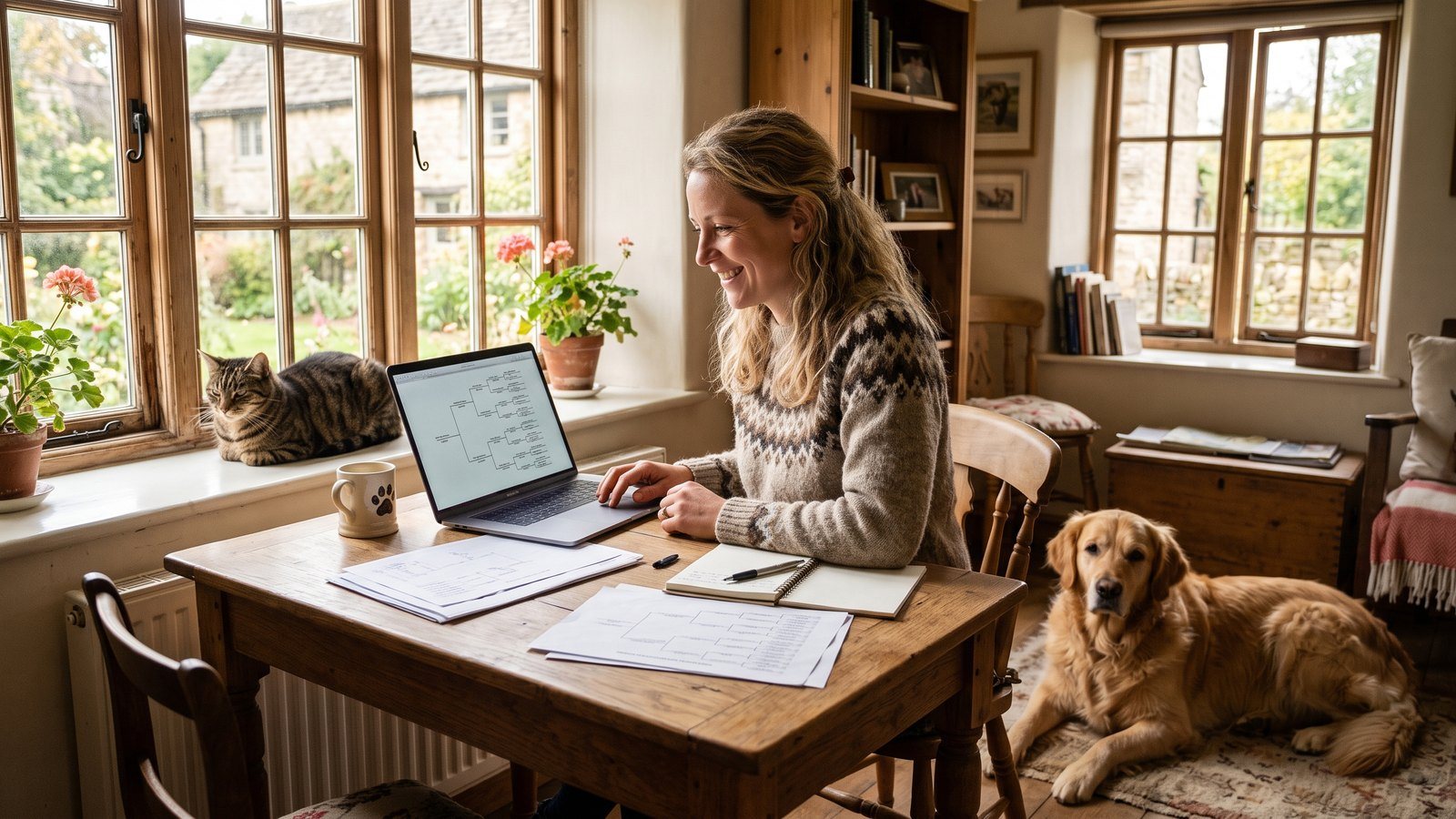
COI is a single number that tells you how closely related the parents of a planned litter are. We explain where it comes from, how to read it and how to use it when choosing a sire.
Every breeder who plans a mating comes across the abbreviation COI sooner or later. The inbreeding coefficient is a single number, but there is a fair amount of genetics behind it: it tells you how closely related the parents of a planned litter are and what you can expect in their offspring. Read correctly, it helps you choose pairings with your eyes open. Read wrongly, it can either lull you into a false sense of security or worry you for no reason. Below we explain where the number comes from, how to interpret it and how to use it in practice, whether you breed dogs, cats or horses.
What the inbreeding coefficient is
The inbreeding coefficient (coefficient of inbreeding, hence COI) was described in the early 20th century by the American geneticist Sewall Wright. Put simply, it is the probability that the two copies of a given gene in an animal come from the same ancestor, in other words that they are identical by descent. Every animal receives one copy of each gene from its mother and one from its father. If the parents share ancestors, the chance rises that both copies are "duplicates" of the same gene from a single ancestor.
COI is usually given as a percentage. A result of 0% means that the parents have no common ancestors in the pedigree that was analysed. A result of 25% means that, on average, one in four gene pairs in the offspring may come from the same ancestor. Bear in mind that this is a statistical value, not a test result for a particular animal.
Wright's formula in plain words
You don't need to calculate COI by hand, but it helps to understand the principle. Wright's formula works like this:
- The sire's and dam's pedigrees are searched for every ancestor that appears on both sides.
- For each common ancestor, every path leading from the sire through that ancestor to the dam is traced.
- Each generation along the path halves the contribution, because only half of a parent's genetic material is passed on at each step.
- The contributions of all paths are added up. If the common ancestor was itself inbred, its contribution is increased accordingly.
Two important points follow from this. First, the closer a common ancestor sits in the pedigree, the more it raises the result. Second, an ancestor who appears many times, even far back, can add up to a surprisingly high COI.
Some reference values for the offspring of parents who are not inbred themselves:
| Relationship between the parents | COI of the offspring |
|---|---|
| full siblings or parent × offspring | 25% |
| half-siblings | 12.5% |
| grandsire × granddaughter | 12.5% |
| first cousins | 6.25% |
In real pedigrees the result is usually higher than these values, because common ancestors further back are added on top of the close relationship.
How many generations to include
This is the most common source of confusion. COI depends on the number of generations analysed. The same planned litter can come out at 3% over five generations and somewhere in the teens over ten, because more common ancestors appear deeper in the pedigree, especially the breed's founders.
- Five generations is a popular minimum. It shows close relationships well but often underestimates the real level of inbreeding.
- Eight to ten generations give a fuller picture, provided the pedigree is complete that far back.
- Pedigree completeness matters. To the formula, a missing ancestor is an unrelated animal, so gaps in the pedigree artificially lower the result.
So only compare results calculated to the same depth and with similarly complete data. A figure from one program over 5 generations and from another over 10 are two different numbers.
How to read the result
There is no single threshold above which a mating is "bad". Treat the ranges below only as a rough guide for a result calculated over several generations:
- below about 5%: usually regarded as low inbreeding,
- about 5–10%: moderate, calls for a deliberate decision and good knowledge of the lines,
- above about 10–12.5%: high, comparable to or greater than a half-sibling mating.
The most important point of reference is the average for your breed. In breeds with a small founding population or a historical "bottleneck", even well-matched pairs can have a higher COI than in numerous breeds. So the sensible question is not only "what is the COI" but also "will this litter raise or lower the average inbreeding in the breed".
Keep the rules of your organisation in mind too. Breeding bodies such as your national kennel club (ZKwP in Poland), cat organisations (for example FIFe or WCF) and horse breeding associations and breed societies (PZHK in Poland) may restrict close matings or require approval for them. The details differ between organisations and breeds, so always check the current breeding regulations of your own organisation.
Inbreeding, line breeding and genetic diversity
Line breeding is a milder form of inbreeding: you pair animals that share an outstanding ancestor further back in order to fix that ancestor's traits. Genetically it is still inbreeding, only weaker and targeted. COI does not distinguish "good" inbreeding from "bad"; it simply measures relatedness.
Inbreeding has its uses: it makes type more uniform and lets traits be passed on more predictably. But it comes at a known price:
- the chance of recessive inherited diseases showing up rises, because the offspring more often receives two copies of the same faulty gene variant,
- inbreeding depression may appear: smaller litters, lower fertility, poorer vitality and immunity in the young,
- across the breed as a whole, genetic diversity falls, and lost gene variants cannot easily be recovered.
A single litter with a higher COI does not decide the health of the offspring. The problem starts when high inbreeding becomes the norm in a breeding programme, or when many breeders use the same popular sire. This is known as the popular sire effect, and it affects dogs, cats and horses alike.
How to use COI when choosing a sire
COI is most useful as a tool for comparison. A practical approach looks like this:
- Draw up a shortlist of candidates based on type, temperament, show or working results and health tests.
- Calculate the COI of the planned litter for each pairing over the same number of generations.
- Check who is behind the result. A good calculator shows the common ancestors and their contribution. A COI raised by a healthy, long-lived ancestor deserves a different assessment from one raised by an ancestor whose descendants have had health problems.
- Set the COI against the health test results. For diseases with a DNA test, knowing the parents' status is worth more than the coefficient alone.
- Think about the next generations. Sometimes it pays to choose a sire from a different line, even one with fewer titles, to keep room for manoeuvre in the future.
The approach is the same for mares and stallions, and for cats in breeds with small populations. Only the availability of pedigree data and the average level of inbreeding in the breed differ.
Frequently asked questions
Does a high COI mean the puppies or kittens will be ill?
No. COI describes a probability, not the condition of a particular animal. A high result increases the risk of recessive defects and inbreeding depression, but it does not make them certain. The health of the offspring also depends on which genes the common ancestors carry.
Why do different programs give a different COI for the same pair?
Most often because they calculate over a different number of generations or hold pedigrees of differing completeness. Only compare results at the same pedigree depth, and check whether ancestors are missing from the data.
How does pedigree COI differ from COI from a genetic test?
Pedigree COI is an expected value calculated from relatedness. Some laboratories report a genomic inbreeding measure based on a DNA test, which shows the actual status of a particular animal. The two approaches complement each other, and the results can differ, because siblings do not inherit identical sections of the genome.
In BreedManager you can calculate the COI of a planned mating in the COI calculator from the pedigrees in your kennel or cattery, with a list of common ancestors and their contribution. You can save the result with the planned mating, next to both parents' health test results, so the whole decision is documented in one place.
Pedigrees, COI, matings, litters with weights, health tests with reminders — for dogs and cats. Free during the beta.
Start free See the breeding software features