Health tests before mating a dog: HD, ED, eyes and DNA tests
8 November 2026 · 7 min read · Dogs
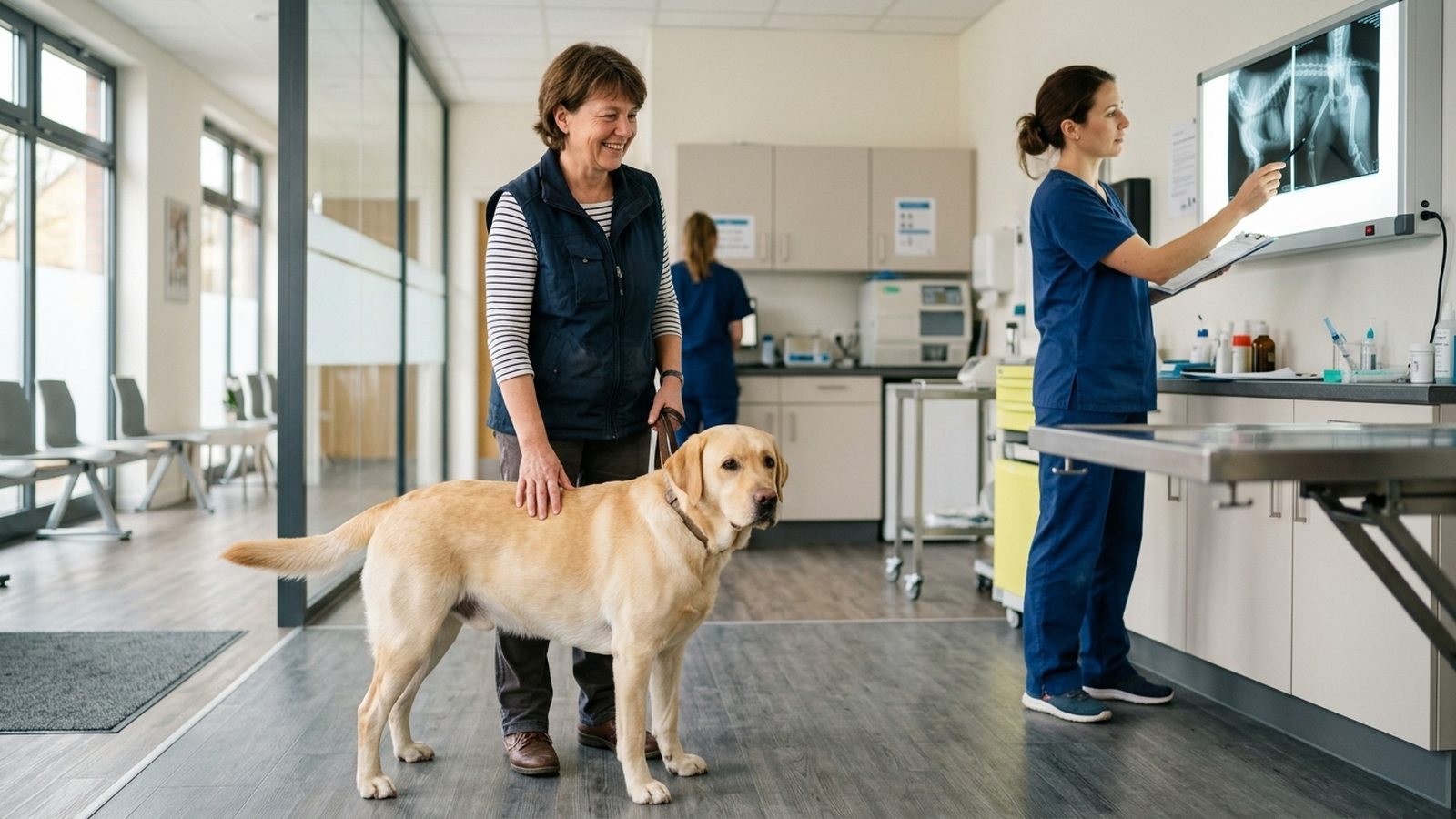
Which tests to do on the bitch and the stud dog before mating, when to do them and how to read the results. A guide to HD, ED, ECVO eye exams, DNA tests and breed-specific checks.
Before you plan a mating, it pays to know as much as possible about both parents. Health tests do not guarantee healthy puppies, but they greatly reduce the risk of passing on diseases that can be detected or predicted. Many breed clubs and breeding regulations require some of these tests before a dog can be approved for breeding, and more and more buyers ask for the results before they even reserve a puppy. Below is an overview of the most important tests: joints, eyes, DNA tests and the extra checks needed in certain breeds.
Hip and elbow dysplasia (HD and ED)
Dysplasia is a developmental joint defect with a polygenic background, also influenced by environmental factors such as feeding and exercise during growth. That is why there is no single DNA test for it, and assessment is based on an X-ray taken and scored according to agreed rules.
Hip scoring (HD) under the FCI system
- A – no signs of dysplasia,
- B – near normal (borderline),
- C – mild dysplasia,
- D – moderate dysplasia,
- E – severe dysplasia.
Elbow grading (ED)
Elbows are usually graded on a scale of 0, 1, 2, 3, where 0 means no changes and 3 means advanced changes. Some systems also include a borderline result.
X-rays are most often taken once the dog is over 12 months old, and in large and giant breeds often after 18 months. The dog is usually sedated so that the joints can be positioned correctly. The official report is prepared by an authorised scrutineer, and the dog's identity is checked against its microchip. Which results are accepted for breeding depends on the breed and the regulations: some breeds require A or B, others also accept C. Check the current rules with your national kennel club (ZKwP in Poland) and your breed club.
Eye examination under the ECVO scheme
Examinations for inherited eye diseases are carried out by a veterinary ophthalmologist authorised to examine under the ECVO (European College of Veterinary Ophthalmologists) protocol. The result is recorded on a standard form, usually valid for about a year, which is why in many breeds the examination is repeated regularly throughout the dog's breeding career.
The examination includes, among other things, checks for:
- progressive retinal atrophy (PRA),
- hereditary cataract,
- collie eye anomaly (CEA),
- retinal dysplasia and persistent pupillary membrane,
- eyelid defects such as entropion and ectropion.
In some breeds gonioscopy is also performed, an assessment of the drainage angle linked to the risk of glaucoma. It is usually done less often than the basic eye examination. Some eye diseases only appear in older dogs, so a single examination before the first mating is not enough.
DNA tests: examples for different breeds
Genetic tests detect specific mutations behind diseases that are most often inherited recessively. A cheek swab or blood sample is taken, and the test only needs to be done once in the dog's life. Examples of commonly performed tests:
| Test | Example breeds |
|---|---|
| prcd-PRA (one form of progressive retinal atrophy) | Labrador Retriever, Poodle, English Cocker Spaniel |
| CEA (collie eye anomaly) | Rough Collie, Border Collie, Shetland Sheepdog |
| MDR1 (sensitivity to certain drugs) | Rough Collie, Australian Shepherd, Shetland Sheepdog |
| DM (degenerative myelopathy) | German Shepherd, Pembroke Welsh Corgi, Boxer |
| EIC (exercise-induced collapse) | Labrador Retriever |
| PLL (primary lens luxation) | terriers, e.g. Jack Russell Terrier |
| vWD type 1 (von Willebrand disease) | Dobermann |
These are only examples. It is best to agree the list of recommended tests for your breed with the breed club, and when choosing a laboratory, check whether samples are taken with the dog's identity verified. Remember too that a "clear" result applies only to the mutation tested. A dog that is clear of prcd-PRA can still develop another form of retinal atrophy, so DNA tests do not replace an eye examination.
Heart, patellas and BOAS: tests in selected breeds
In some breeds, additional tests are standard:
- Heart – auscultation, and echocardiography in predisposed breeds. For Dobermanns, screening for dilated cardiomyopathy usually means a heart echo and Holter monitoring repeated every year. In Cavalier King Charles Spaniels the key issue is degenerative mitral valve disease, and in Boxers rhythm disorders as well.
- Patellas – patellar luxation is assessed in an orthopaedic examination, most often on a scale from 0 (none) to 4. This mainly concerns small and toy breeds, such as the Yorkshire Terrier, Pomeranian or Chihuahua.
- BOAS – brachycephalic obstructive airway syndrome in short-nosed breeds. A functional breathing assessment, often following the scheme developed at the University of Cambridge, is increasingly carried out on Pugs, French Bulldogs and English Bulldogs.
Interpreting the results and deciding whether a dog is suitable for breeding is a matter for the vet and the rules of your breed.
When to do the tests
A well-planned testing calendar saves a lot of stress just before your bitch comes into season:
- DNA tests – can be done at any age, even in puppies. The earlier, the easier it is to plan future matings.
- HD and ED – once the dog reaches the minimum age required for the breed, usually before breeding approval.
- Eyes – before the first mating and then regularly, typically every year or as the club recommends.
- Heart and other breed-specific tests – according to the breed health programme, often repeated in later years.
Check the stud dog's results as well before you book the mating. A reliable stud owner will be happy to share copies of current certificates.
Carrier × clear: how recessive diseases are inherited
Most diseases detected by DNA tests are inherited in an autosomal recessive way. An affected dog has two copies of the mutation, a carrier has one and a clear dog has none. Carriers usually stay healthy but pass the mutation on to their offspring. Statistically, for each puppy it looks like this:
- clear × clear – all puppies clear,
- carrier × clear – about 50% clear and 50% carriers, none affected,
- affected × clear – all puppies carriers, none affected,
- carrier × carrier – about 25% clear, 50% carriers and 25% affected.
This means a carrier does not have to be excluded from breeding automatically. Mating to a clear dog produces healthy puppies, and removing all carriers in small breeds could narrow the gene pool unnecessarily. Puppies from such a litter are worth testing, and buyers should be told their status. This does not apply to diseases with a different mode of inheritance, such as dominant ones, where other rules apply. Discuss the details with your vet or the laboratory.
Keeping your records
Test results are part of your kennel's history. Keep the original certificates and scans in one place, note the date of each test and its expiry date (for example for eye examinations), and make sure every result is assigned to the right dog. The microchip number shown on the certificates should be available for the club and the puppy buyer to see, but don't publish it in adverts or on your kennel website.
Frequently asked questions
Can a dog with an HD C result be used for breeding?
It depends on the breed and the regulations. In some breeds a C result is acceptable, sometimes on condition that the dog is mated to a partner scored A or B; in others it rules the dog out. Check the current rules with your breed club and national kennel club (ZKwP in Poland).
If the parents are DNA tested, do the puppies still need testing?
If both parents are confirmed clear, the puppies are also clear of that mutation and are often described as clear by parentage. If one parent is a carrier, the puppies need to be tested to find out their status.
How often should the eye examination be repeated?
Most often about every 12 months throughout the dog's breeding career, because some eye diseases appear with age. The exact requirements are set by the breed club.
In BreedManager you can record each dog's test results using the health test dictionary, and the system will remind you when an eye or heart examination is due again. When planning a mating you have both parents' results side by side, and the COI calculator completes the picture with their relatedness.
Pedigrees, COI, matings, litters with weights, health tests with reminders — for dogs and cats. Free during the beta.
Start free See the breeding software features